
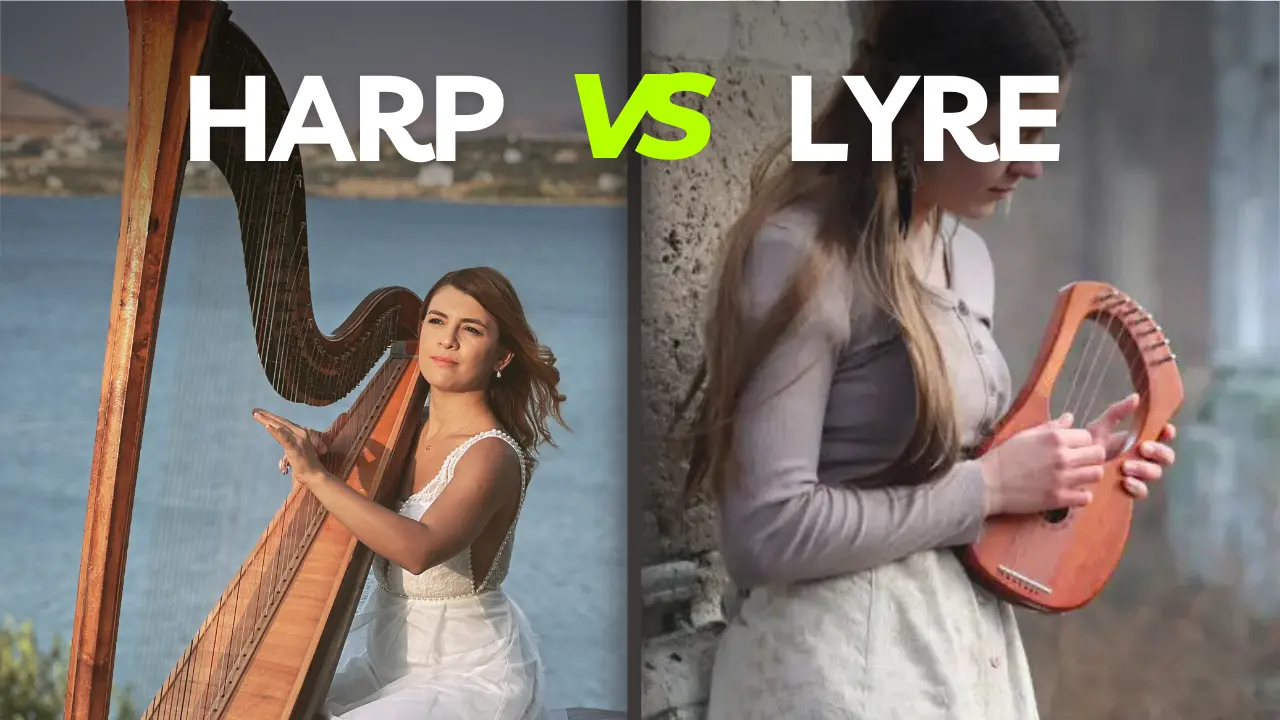
When I began learning about the lyre harp, I searched for answers to this very question and found many resources to be inaccurate or not make sense. Therefore, I decided to write my own article based on independent research and understanding.
First, let’s address the easier question.
Is a “Lyre Harp” a Type of Harp?
For some reason, the term “lyre harp” agitates some people, as if it has personally offended them. Often, these individuals come from a harp background, and they believe that adding “harp” after “lyre” suggests that the instrument is a type of harp – a notion they find unacceptable. (My question to them is: is a hot dog really a dog?)
To clarify this misunderstanding, I’d like to set the record straight:
A “lyre harp” is not a harp. They are different instruments.
Are “Lyre Harp” and “Lyre” the Same?
These terms are often used to refer to similar-looking instruments. Some people call it a “lyre harp,” while others refer to it as a “lyre”. It’s only natural to wonder if they are the same thing. To clarify:
A “lyre harp” is simply a lyre.
The term “lyre harp” is used to distinguish it from the “lyre glockenspiel,” a completely different instrument that looks like a xylophone. I’ve found that using the term “lyre harp” increases the odds of my content reaching the right audience.
When I first became interested in playing the lyre, I searched for “lyre tutorials,” but all I got were glockenspiel tutorials! Thankfully, things have changed since then because I and other enthusiasts in the lyre harp community have been putting out content for the lyre harp.
Now, I use “lyre” and “lyre harp” interchangeably.
Regarding the terms, some people have suggested that manufacturers use “lyre harp” to increase the chance of people coming across this instrument because of the association with the harp. Wait a minute… was that how I discovered this instrument in the first place? Could be!
Key Differences Between a Harp and a Lyre
Understandably, there might be some confusion between the harp and the lyre, as they appear similar. Both instruments have strings that extend from the body to the tuning pins on an arch-like piece. Both are plucked with the fingers. Plus, they both make their players look fantastic (it’s true, you know)!
However, their differences lie in their design. Let’s break it down.
Size
The most obvious difference is size. Harps come in various sizes, from small lap harps to large concert-sized, 80-pound pedal harps that can be quite cumbersome to move.
In contrast, the lyre harp is lighter and much more portable. It can be played on a person’s lap, on a table (like a zither), or while standing or sitting by using a telamon (a fancy word for a hand strap).
Construction
In a harp, the strings pass directly through the instrument’s soundboard to the tuning pins. You’ll also notice that the soundboard descends at an angle, with an arched neck (where the tuning pins are) supported by a column. This design accounts for the different string tensions required for each note; the high-pitched strings are shorter than the low-pitched ones.
On the lyre harp, particularly modern ones, the strings pass through the instrument’s body and are stopped by the metal ball end of each string (much like on a guitar). The strings will go one of two ways toward the tuning pins:
- Over a raised bridge: This could be a piece of wood or metal glued to the body, a raised piece of wood carved into the body acting like a bridge.
- Straight from the body to the tuning pins without going over a bridge: This setup is more reminiscent of a harp.
The tuning pins are generally fixed to the top of the lyre harp. Depending on the design, the tuning pins and bridge may arch to make the high-pitched strings gradually shorter, similar to a harp, but this varies by model.
Playing Technique
The playing technique also differs between the harp and the lyre.
In a harp, the soundboard rests on the player’s shoulder, allowing them to pluck the strings with their fingers on either side.
The lyre harp, on the other hand, generally sits on a player’s lap and is held by one of the arms with one hand, allowing the other to pluck the strings with either fingers or a plectrum. It can also be played flat on a table or upright with a telamon (hand strap).
Tuning Differences
There are notable differences in tuning between the harp and the lyre.
The harp is generally tuned to a diatonic scale (though some variations exist, such as the chromatic tuning of a cross-strung harp). The larger harps have more strings, giving them a wider range of notes. Depending on the harp model, players can quickly raise a string by a semi-tone using either levers next to the tuning pins or pedals at the base of the harp. In contrast, re-tuning a lyre harp can be less expedient.
The lyre harp can be found in pentatonic, diatonic, and chromatic scales. Each lyre is built for a particular scale, and it is generally not recommended to re-tune it to a different one. The number of strings also varies from instrument to instrument, ranging from 6 to over 30. Generally, lyre harps with fewer strings are designed for a pentatonic scale, while those with more strings are usually tuned chromatically, with diatonic lyres often falling in between. However, this is not always the case.
It’s also worth noting that there’s no quick way to re-tune a lyre harp. Unlike some harps, which have pedals or levers for easy key changes, a lyre harp requires you to break out the tuner and tuning wrench to adjust the key.
Final Thoughts: Choose the Right Instrument
With all this information, I hope to clarify the differences between the lyre, the harp, and the lyre harp. My goal is to help anyone interested in these instruments to choose the right one for their needs, ensuring the perfect instrument arrives at their door!
Enjoy your musical journey!
