
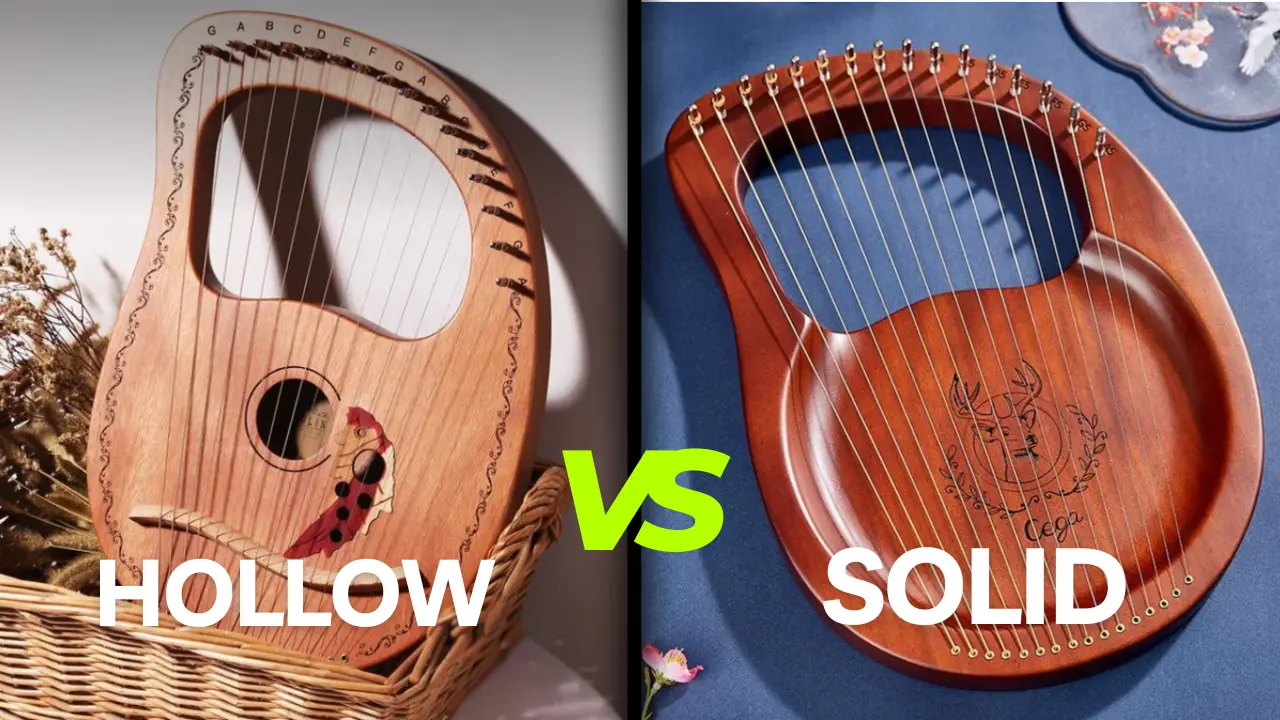
When shopping for a lyre harp, you’ll encounter two main types: solid-body and hollow-body. Both designs boast beautiful aesthetics and, when crafted with care, can provide years of musical enjoyment.
Yet, there’s an ongoing debate about the sound qualities of each type – specifically, whether solid-body lyres are inferior in volume and tone compared to their hollow-bodied counterparts.
While there may be subtle differences in tone and volume between solid-body and hollow-body lyres, the size of most lyre harps makes these differences almost negligible. Both designs deliver a great tone and volume for an instrument that is, for most people, an intimate musical experience.
Differences in Construction
Solid-body lyres are generally made from solid pieces of wood without any hollow sections. The resonance, projection, and tone come from the vibrations of the strings on that solid piece of wood.
In contrast, hollow-body lyres (also labeled as “chambered” or “sound box” lyres) are constructed with a sound box akin to that of an acoustic guitar. This enclosed space allows sound to be projected more broadly.
However, the assumption that hollow-body lyres are louder and, therefore, better isn’t always accurate!
Does Construction Affect Sound?
While both solid-body and hollow-body construction have their differences, there are some characteristics of the lyre harp to consider.
Size Matters
Lyre harps are small instruments that are generally meant for fun, meditative play. The enjoyment is mainly for the player, who holds the instrument close to them. A quick look at most commercial lyre harps reveals only slight size differences between solid and hollow-body lyres.
For a soundbox to be effective, it generally needs to be considerably larger to amplify sound (like chromatic lyres). The odds are good that, given the small size of most lyre harps, the difference in volume between both types of construction is negligible and unlikely to impede the player’s enjoyment.
The Role of Materials in Sound Quality
The quality and type of materials used in the construction of a lyre harp can significantly impact its overall sound, particularly the top of the instrument where the resonance and projection come from. High-quality acoustic instruments often utilize spruce or cedar for their tops for their excellent sound properties.
Most inexpensive lyre harps are made from mahogany which, while used in instrument construction, is generally not used for the resonant top. While hollow-bodied lyres may project a little more sound, the instrument’s small size makes little difference.
Amplifying Your Lyre Harp Sound
If you desire a louder sound, there are several methods to amplify your lyre harp, regardless of its construction.
One recommendation from Alexandru, skilled luthier at Nisoria Lyres, is to play your lyre harp on a table. This technique helps to enhance its vibrations and project a louder sound. Although it shifts the playing position from a more personal, intimate style to a broader, outward focus, many players find that this adjustment can significantly boost their instrument’s volume.
In addition to this playing technique, various pickup solutions exist for these instruments, allowing them to be easily modified to run into an amplifier. There! Problem solved! With these tips, you’ll be on your way to a richer, more resonant playing experience!
Conclusion: Solid-Body vs. Hollow-Body Lyre Harps
When it comes to the solid-body versus hollow-body debate, it’s important to note that this distinction is only significant with larger lyres, such as chromatic lyres. For most smaller lyres, the differences may not be as pronounced and shouldn’t deter you from exploring the options available!
While popular opinion may favor the hollow-body lyres, dismissing solid-body models outright would be a mistake!
Each style has its own unique tonal qualities, and you might be pleasantly surprised by the sound and playability of a solid-body lyre. So, take the time to try both varieties. Let your ears guide your choice! Who knows, your favorite lyre harp may not be what you expected!
